
The Persistence Architecture of E-Learning: Linking Quality, Acceptance, and Student Satisfaction
Article Sidebar
Main Article Content
Abstract
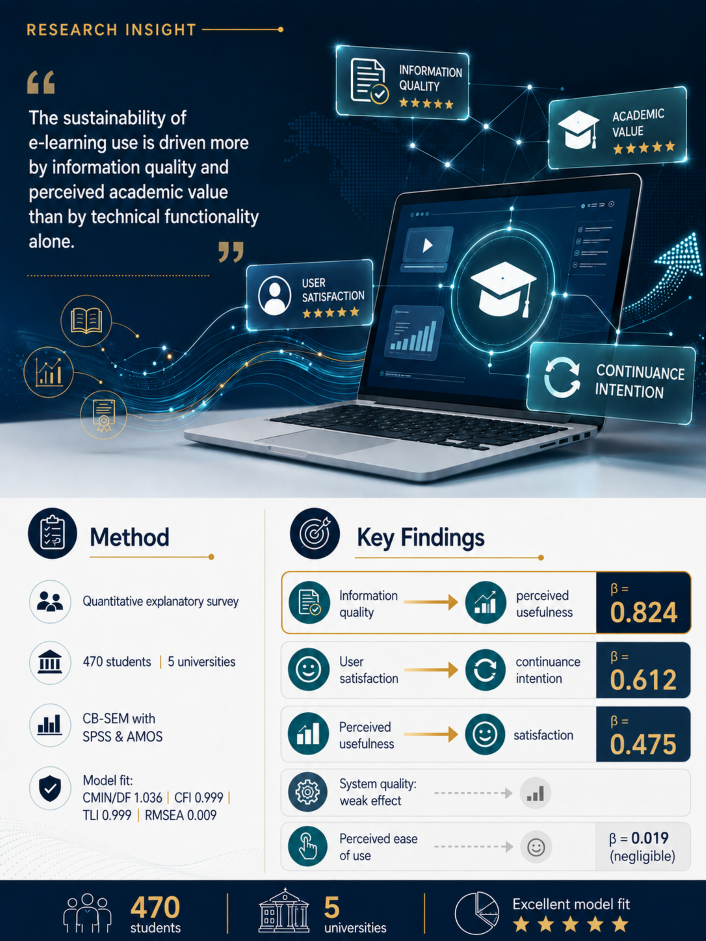
E-learning sustainability depends on students’ post-adoption evaluations of platform performance, information quality, usefulness, satisfaction, and continued use. This study examines students’ continuance intention toward institutional e-learning systems by integrating the Technology Acceptance Model and the Information Systems Success Model. A quantitative explanatory survey was conducted with 470 students from five Indonesian universities. Data were analyzed using covariance-based structural equation modeling with IBM SPSS and AMOS. The final model showed excellent fit (CMIN/DF = 1.036, CFI = 0.999, TLI = 0.999, RMSEA = 0.009). The results reveal that information quality was the dominant driver of perceived usefulness (β = 0.824, p < 0.001) and also significantly improved perceived ease of use (β = 0.321, p < 0.001). User satisfaction strongly predicted continuance intention (β = 0.612, p < 0.001), while perceived usefulness substantially increased satisfaction (β = 0.475, p < 0.001). By contrast, system quality had only weak effects on perceived ease of use (β = 0.164) and perceived usefulness (β = 0.072), and perceived ease of use had a negligible effect on satisfaction (β = 0.019). These findings show that sustained e-learning use is shaped primarily by the quality and academic value of information rather than by technical functionality alone. The study refines TAM–ISSM integration by identifying a clear information quality–usefulness–satisfaction–continuance pathway in post-adoption settings. Universities should therefore prioritize relevant, accurate, well-organized, and timely learning content, while maintaining reliable system performance, to strengthen student satisfaction and long-term engagement.
Downloads
Article Details

This work is licensed under a Creative Commons Attribution-ShareAlike 4.0 International License.
Authors who publish with this journal agree to the following terms:
- Copyright of the published article belongs to the authors and grant the journal right of first publication with the work simultaneously licensed under a Creative Commons Attribution-ShareAlike 4.0 (CC BY SA) International License that allows others to share the work with an acknowledgment of the work's authorship and initial publication in this journal.
- Authors are able to enter into separate, additional contractual arrangements for the non-exclusive distribution of the journal's published version of the work (e.g., post it to an institutional repository or publish it in a book), with an acknowledgment of its initial publication in this journal.
- Authors are permitted and encouraged to post their work online (e.g., in institutional repositories or on their website) prior to and during the submission process, as it can lead to productive exchanges, as well as earlier and greater citation of published work (See the Effect of Open Access).
References
[1] A. S. Al-Adwan, N. A. Albelbisi, O. Hujran, W. M. Al-Rahmi, and A. Alkhalifah, “Developing a holistic success model for sustainable e-learning: A structural equation modeling approach,” Sustain., vol. 13, no. 16, p. 9453, 2021, https://doi.org/10.3390/su13169453
[2] D. Al-Fraihat, M. Joy, and J. Sinclair, “Evaluating E-learning systems success: An empirical study,” Comput. Human Behav., vol. 102, pp. 67–86, 2020, https://doi.org/10.1016/j.chb.2019.08.004
[3] R. C. Clark and R. E. Mayer, e-Learning and the Science of Instruction: Proven Guidelines for Consumers and Designers of Multimedia Learning: Third Edition. john Wiley & sons, 2012. https://doi.org/10.1002/9781118255971
[4] L. Harasim, “Shift happens: Online education as a new paradigm in learning,” Internet High. Educ., vol. 3, no. 1–2, pp. 41–61, 2000, https://doi.org/10.1016/S1096-7516(00)00032-4
[5] P. C. Sun, R. J. Tsai, G. Finger, Y. Y. Chen, and D. Yeh, “What drives a successful e-Learning? An empirical investigation of the critical factors influencing learner satisfaction,” Comput. Educ., vol. 50, no. 4, pp. 1183–1202, 2008, https://doi.org/10.1016/j.compedu.2006.11.007
[6] S. Ozkan and R. Koseler, “Multi-dimensional evaluation of E-learning systems in the higher education context: An empirical investigation of a computer literacy course,” Proc. - Front. Educ. Conf. FIE, vol. 53, no. 4, pp. 1285–1296, 2009, https://doi.org/10.1109/FIE.2009.5350590
[7] H. M. Selim, “Critical success factors for e-learning acceptance: Confirmatory factor models,” Comput. Educ., vol. 49, no. 2, pp. 396–413, 2007, https://doi.org/10.1016/j.compedu.2005.09.004
[8] A. Bhattacherjee, “Understanding information systems continuance: An expectation-confirmation model,” MIS Q. Manag. Inf. Syst., vol. 25, no. 3, pp. 351–370, 2001, https://doi.org/10.2307/3250921
[9] J. Dai, X. Zhang, and C. Wang, “A meta-analysis of learners’ continuance intention toward online education platforms,” Educ. Inf. Technol., vol. 29, no. 16, pp. 21833–21868, 2024, https://doi.org/10.1007/s10639-024-12654-7
[10] V. Venkatesh, M. G. Morris, G. B. Davis, and F. D. Davis, “User acceptance of information technology: Toward a unified view,” MIS Q. Manag. Inf. Syst., vol. 27, no. 3, pp. 425–478, 2003, https://doi.org/10.2307/30036540
[11] D. Legramante, A. Azevedo, and J. M. Azevedo, “Integration of the technology acceptance model and the information systems success model in the analysis of Moodle’s satisfaction and continuity of use,” Int. J. Inf. Learn. Technol., vol. 40, no. 5, pp. 467–484, 2023, https://doi.org/10.1108/IJILT-12-2022-0231
[12] A. Ramadhan, A. N. Hidayanto, G. A. Salsabila, I. Wulandari, J. A. Jaury, and N. N. Anjani, “The effect of usability on the intention to use the e-learning system in a sustainable way: A case study at Universitas Indonesia,” Educ. Inf. Technol., vol. 27, no. 2, pp. 1489–1522, 2022, https://doi.org/10.1007/s10639-021-10613-0
[13] C. Wang, J. Dai, K. Zhu, T. Yu, and X. Gu, “Understanding the Continuance Intention of College Students toward New E-Learning Spaces Based on an Integrated Model of the TAM and TTF,” Int. J. Hum. Comput. Interact., vol. 40, no. 24, pp. 8419–8432, 2024, https://doi.org/10.1080/10447318.2023.2291609
[14] F. D. Davis, “Perceived usefulness, perceived ease of use, and user acceptance of information technology,” MIS Q. Manag. Inf. Syst., vol. 13, no. 3, pp. 319–339, 1989, https://doi.org/10.2307/249008
[15] V. Venkatesh and F. D. Davis, “Theoretical extension of the Technology Acceptance Model: Four longitudinal field studies,” Manage. Sci., vol. 46, no. 2, pp. 186–204, 2000, https://doi.org/10.1287/mnsc.46.2.186.11926
[16] C. Sayginer, “Examining University Students’ Behavioural Intention To Distance Learning During Covid-19: an Extended Tam Model,” Turkish Online J. Distance Educ., vol. 24, no. 2, pp. 325–336, 2023, https://doi.org/10.17718/tojde.1123213
[17] D. Pal and V. Vanijja, “Perceived usability evaluation of Microsoft Teams as an online learning platform during COVID-19 using system usability scale and technology acceptance model in India,” Child. Youth Serv. Rev., vol. 119, p. 105535, 2020, https://doi.org/10.1016/j.childyouth.2020.105535
[18] A. Revythi and N. Tselios, “Extension of technology acceptance model by using system usability scale to assess behavioral intention to use e-learning,” Educ. Inf. Technol., vol. 24, no. 4, pp. 2341–2355, 2019, https://doi.org/10.1007/s10639-019-09869-4
[19] A. Sinha and S. Bag, “Intention of postgraduate students towards the online education system: application of extended technology acceptance model,” J. Appl. Res. High. Educ., vol. 15, no. 2, pp. 369–391, 2023, https://doi.org/10.1108/JARHE-06-2021-0233
[20] I. Waris and I. Hameed, “Modeling teachers acceptance of learning management system in higher education during COVID-19 pandemic: A developing country perspective,” J. Public Aff., vol. 23, no. 1, p. e2821, 2023, https://doi.org/10.1002/pa.2821
[21] W. H. DeLone and E. R. McLean, “Information systems success: The quest for the dependent variable,” Inf. Syst. Res., vol. 3, no. 1, pp. 60–95, 1992, https://doi.org/10.1287/isre.3.1.60
[22] W. H. DeLone and E. R. McLean, “The DeLone and McLean model of information systems success: A ten-year update,” J. Manag. Inf. Syst., vol. 19, no. 4, pp. 9–30, 2003, https://doi.org/10.1080/07421222.2003.11045748
[23] A. Hassanzadeh, F. Kanaani, and S. Elahi, “A model for measuring e-learning systems success in universities,” Expert Syst. Appl., vol. 39, no. 12, pp. 10959–10966, 2012, https://doi.org/10.1016/j.eswa.2012.03.028
[24] A. M. Sayaf, “Adoption of E-learning systems: An integration of ISSM and constructivism theories in higher education,” Heliyon, vol. 9, no. 2, 2023, https://doi.org/10.1016/j.heliyon.2023.e13014
[25] R. L. Oliver, “A Cognitive Model of the Antecedents and Consequences of Satisfaction Decisions,” J. Mark. Res., vol. 17, no. 4, p. 460, 1980, https://doi.org/10.2307/3150499
[26] I. Y. Alyoussef, “Acceptance of e-learning in higher education: The role of task-technology fit with the information systems success model,” Heliyon, vol. 9, no. 3, 2023, https://doi.org/10.1016/j.heliyon.2023.e13751
[27] S. Xiao and M. Warkentin, “User Experience, Satisfaction, and Continual Usage Intention of IT: A Replication Study in China,” AIS Trans. Replication Res., vol. 7, no. 1, pp. 60–75, 2021, https://doi.org/10.17705/1atrr.00070
[28] P. B. Seddon, “A Respecification and Extension of the DeLone and McLean Model of IS Success,” Inf. Syst. Res., vol. 8, no. 3, pp. 240–253, 1997, https://doi.org/10.1287/isre.8.3.240
[29] J. S. Mtebe and C. Raphael, “Key factors in learners’ satisfaction with the e-learning system at the University of Dar es Salaam, Tanzania,” Australas. J. Educ. Technol., vol. 34, no. 4, pp. 107–122, 2018, https://doi.org/10.14742/ajet.2993
[30] H. Soongeun, K. Jeoungkun, and L. Heeseok, “Antecedents of Use-Continuance in Information Systems: Toward an Inegrative View,” J. Comput. Inf. Syst., vol. 48, no. 3, pp. 61–73, 2008, https://doi.org/10.1080/08874417.2008.11646022
[31] A. Jeyaraj, Y. K. Dwivedi, and V. Venkatesh, “Intention in information systems adoption and use: Current state and research directions,” International Journal of Information Management, vol. 73. Elsevier, p. 102680, 2023. https://doi.org/10.1016/j.ijinfomgt.2023.102680
[32] H. Al-Samarraie, B. K. Teng, A. I. Alzahrani, and N. Alalwan, “E-learning continuance satisfaction in higher education: a unified perspective from instructors and students,” Stud. High. Educ., vol. 43, no. 11, pp. 2003–2019, 2018, https://doi.org/10.1080/03075079.2017.1298088
[33] M. T. Rajeh et al., “Students’ satisfaction and continued intention toward e-learning: a theory-based study,” Med. Educ. Online, vol. 26, no. 1, p. 1961348, 2021, https://doi.org/10.1080/10872981.2021.1961348
[34] A. AL-Hawamleh, “Exploring the Satisfaction and Continuance Intention to Use E-Learning Systems,” Int. J. Electr. Comput. Eng. Syst., vol. 15, no. 2, pp. 201–214, 2024, https://doi.org/10.32985/ijeces.15.2.8
[35] F. Fitria, M. Yahya, M. I. Ali, P. Purnamawati, and A. M. Mappalotteng, “The Impact of System Quality and User Satisfaction: The Mediating Role of Ease of Use and Usefulness in E-Learning Systems,” Int. J. Environ. Eng. Educ., vol. 6, no. 2, pp. 119–131, 2024, https://doi.org/10.55151/ijeedu.v6i2.134
[36] K. T. Upadhyaya and D. Mallik, “E-Learning as a Socio-Technical System: An Insight into Factors Influencing its Effectiveness,” Bus. Perspect. Res., vol. 2, no. 1, pp. 1–12, 2013, https://doi.org/10.1177/2278533720130101
[37] S. Mystakidis, E. Berki, and J. P. Valtanen, “Deep and meaningful e-learning with social virtual reality environments in higher education: A systematic literature review,” Appl. Sci., vol. 11, no. 5, p. 2412, 2021, https://doi.org/10.3390/app11052412
[38] E. M. Meyers, I. Erickson, and R. V. Small, “Digital literacy and informal learning environments: An introduction,” Learn. Media Technol., vol. 38, no. 4, pp. 355–367, 2013, https://doi.org/10.1080/17439884.2013.783597
[39] M. I. Alkhawaja, M. S. A. Halim, M. S. S. Abumandil, and A. S. Al-Adwan, “System Quality and Student’s Acceptance of the E-learning System: The Serial Mediation of Perceived Usefulness and Intention to Use,” Contemp. Educ. Technol., vol. 14, no. 2, 2022, https://doi.org/10.30935/CEDTECH/11525
[40] R. S. Alotaibi and S. M. Alshahrani, “An extended DeLone and McLean’s model to determine the success factors of e-learning platform,” PeerJ Comput. Sci., vol. 8, p. e876, 2022, https://doi.org/10.7717/peerj-cs.876
[41] A. F. Di Natale, S. Bartolotta, A. Gaggioli, G. Riva, and D. Villani, “Exploring students’ acceptance and continuance intention in using immersive virtual reality and metaverse integrated learning environments: The case of an Italian university course,” Educ. Inf. Technol., vol. 29, no. 12, pp. 14749–14768, 2024, https://doi.org/10.1007/s10639-023-12436-7
[42] F. Aziz, C. Li, and A. U. Khan, “Immersive learning in virtual worlds: A two-step analysis SEM and NCA for assessing the impact of Metaverse education on knowledge retention and student collaboration,” Technol. Soc., vol. 81, p. 102871, 2025, https://doi.org/10.1016/j.techsoc.2025.102871
[43] D. Buragohain, S. Chaudhary, G. Punpeng, A. Sharma, N. Am-In, and L. Wuttisittikulkij, “Analyzing the Impact and Prospects of Metaverse in Learning Environments Through Systematic and Case Study Research,” IEEE Access, vol. 11, pp. 141261–141276, 2023, https://doi.org/10.1109/ACCESS.2023.3340734
[44] A. R. Alkhuwaylidee, “Exploring Factors Influencing Students’ Continuance Intention to Use E-Learning System for Iraqi University Students,” Computers, vol. 14, no. 5, p. 176, 2025, https://doi.org/10.3390/computers14050176
[45] M. A. Alterkait and M. Y. Alduaij, “Impact of Information Quality on Satisfaction with E-Learning Platforms: Moderating Role of Instructor and Learner Quality,” SAGE Open, vol. 14, no. 1, p. 21582440241233400, 2024, https://doi.org/10.1177/21582440241233400
[46] M. N. Ayubi and A. Retnowardhani, “Optimizing Learning Experiences: A Study of Student Satisfaction with LMS in Higher Education,” APTISI Trans. Technopreneursh., vol. 7, no. 2, pp. 527–541, 2025, https://doi.org/10.34306/att.v7i2.501
[47] Rulinawaty et al., “Investigating the influence of the updated DeLone and McLean information system (IS) success model on the effectiveness of learning management system (LMS) implementation,” Cogent Educ., vol. 11, no. 1, p. 2365611, 2024, https://doi.org/10.1080/2331186X.2024.2365611
[48] J. Vinueza-Martínez, “E-learning service quality and student satisfaction in public universities: a quantitative hierarchisation of determinants through systematic review,” in Frontiers in Education, 2026, vol. 11, p. 1818648, https://doi.org/10.3389/feduc.2026.1818648
[49] H. Elmunsyah, A. Nafalski, A. P. Wibawa, and F. A. Dwiyanto, “Understanding the Impact of a Learning Management System Using a Novel Modified DeLone and McLean Model,” Educ. Sci., vol. 13, no. 3, p. 235, 2023, https://doi.org/10.3390/educsci13030235
[50] C. Buabeng-Andoh, “Investigating student–teachers’ continuous intention to use mobile learning management system: the technology acceptance model and expectation confirmatory model,” Discov. Educ., vol. 4, no. 1, p. 76, 2025, https://doi.org/10.1007/s44217-025-00447-0
[51] K. Dai, H. Jiao, H. Wang, and L. He, “Application and effect analysis of virtual reality technology in innovation and entrepreneurship education,” Appl. Math. Nonlinear Sci., vol. 9, no. 1, 2024, https://doi.org/10.2478/amns-2024-1614
[52] G. Pan, Y. Mao, Z. Song, and H. Nie, “Research on the influencing factors of adult learners’ intent to use online education platforms based on expectation confirmation theory,” Sci. Rep., vol. 14, no. 1, p. 12762, 2024, https://doi.org/10.1038/s41598-024-63747-9
[53] F. Huang and S. Liu, “If I Enjoy, I Continue: The Mediating Effects of Perceived Usefulness and Perceived Enjoyment in Continuance of Asynchronous Online English Learning,” Educ. Sci., vol. 14, no. 8, p. 880, 2024, https://doi.org/10.3390/educsci14080880
[54] S. A. Salloum, A. Qasim Mohammad Alhamad, M. Al-Emran, A. Abdel Monem, and K. Shaalan, “Exploring students’ acceptance of e-learning through the development of a comprehensive technology acceptance model,” IEEE Access, vol. 7, pp. 128445–128462, 2019, https://doi.org/10.1109/ACCESS.2019.2939467
[55] B. Al-shargabi, O. Sabri, and S. Aljawarneh, “The adoption of an e-learning system using information systems success model: a case study of Jazan University,” PeerJ Comput. Sci., vol. 7, pp. 1–21, 2021, https://doi.org/10.7717/peerj-cs.723
[56] L. Alzahrani and K. P. Seth, “Factors influencing students’ satisfaction with continuous use of learning management systems during the COVID-19 pandemic: An empirical study,” Educ. Inf. Technol., vol. 26, no. 6, pp. 6787–6805, 2021, https://doi.org/10.1007/s10639-021-10492-5
[57] A. Shahzad, R. Hassan, A. Y. Aremu, A. Hussain, and R. N. Lodhi, “Effects of COVID-19 in E-learning on higher education institution students: the group comparison between male and female,” Qual. Quant., vol. 55, no. 3, pp. 805–826, 2021, https://doi.org/10.1007/s11135-020-01028-z
[58] J. C. Anderson and D. W. Gerbing, “Structural Equation Modeling in Practice: A Review and Recommended Two-Step Approach,” Psychol. Bull., vol. 103, no. 3, pp. 411–423, 1988, https://doi.org/10.1037/0033-2909.103.3.411
[59] J. F. Hair Jr., W. C. Black, B. J. Babin, and R. E. Anderson, Multivariate Data Analysis, 8th ed. Andover, UK: Cengage, 2019. [Online]. Available: https://au.cengage.com/c/isbn/9781473756540/
[60] R. B. Kline, Principles and Practice of Structural Equation Modeling, 5th ed. New York, USA: The Guilford Press, 2023. [Online]. Available: https://www.guilford.com/books/Principles-and-Practice-of-Structural-Equation-Modeling/Rex-Kline/9781462551910
[61] R. W. Brislin, “Back-translation for cross-cultural research,” J Cross Cult Psychol., vol. 1, pp. 185–216, 1970. https://doi.org/10.1177/135910457000100301
[62] C. Fornell and D. F. Larcker, “Evaluating Structural Equation Models with Unobservable Variables and Measurement Error,” J. Mark. Res., vol. 18, no. 1, p. 39, 1981, https://doi.org/10.2307/3151312
[63] J. Henseler, C. M. Ringle, and M. Sarstedt, “A new criterion for assessing discriminant validity in variance-based structural equation modeling,” J. Acad. Mark. Sci., vol. 43, no. 1, pp. 115–135, 2015, https://doi.org/10.1007/s11747-014-0403-8
[64] L. T. Hu and P. M. Bentler, “Cutoff criteria for fit indexes in covariance structure analysis: Conventional criteria versus new alternatives,” Struct. Equ. Model., vol. 6, no. 1, pp. 1–55, 1999, https://doi.org/10.1080/10705519909540118
[65] R. E. Schumacker and R. G. Lomax, A Beginner’s Guide to Structural Equation Modeling, 3rd ed. Mahwah, NJ: Lawrence Erlbaum Associates, 2015. https://doi.org/10.4324/9781315749105
[66] H. W. Marsh, K. T. Hau, and Z. Wen, “In search of golden rules: Comment on hypothesis-testing approaches to setting cutoff values for fit indexes and dangers in overgeneralizing Hu and Bentler’s (1999) findings,” Struct. Equ. Model., vol. 11, no. 3, pp. 320–341, 2004, https://doi.org/10.1207/s15328007sem1103_2
[67] G. W. Cheung, H. D. Cooper-Thomas, R. S. Lau, and L. C. Wang, “Reporting reliability, convergent and discriminant validity with structural equation modeling: A review and best-practice recommendations,” Asia Pacific J. Manag., vol. 41, no. 2, pp. 745–783, 2024, https://doi.org/10.1007/s10490-023-09871-y
[68] J. C. Nunnally and I. H. Bernstein, “The Assessment of Reliability,” in Psychometric Theory, 3rd ed., New York, USA: McGraw-Hill Education, 1994, pp. 248–292. [Online]. Available: https://books.google.com/books?id=r0fuAAAAMAAJ
[69] R. P. Bagozzi and Y. Yi, “On the evaluation of structural equation models,” J. Acad. Mark. Sci., vol. 16, no. 1, pp. 74–94, 1988, https://doi.org/10.1007/BF02723327
[70] M. Sarstedt, C. M. Ringle, and J. F. Hair, “Partial Least Squares Structural Equation Modeling,” Handbook of Market Research. Springer Nature, pp. 587–632, 2021. https://doi.org/10.1007/978-3-319-57413-4_15
[71] J. F. Hair Jr., L. M. Matthews, R. L. Matthews, and M. Sarstedt, “PLS-SEM or CB-SEM: updated guidelines on which method to use,” Int. J. Multivar. Data Anal., vol. 1, no. 2, p. 107, 2017, https://doi.org/10.1504/ijmda.2017.10008574
[72] K. Schermelleh-Engel, H. Moosbrugger, and H. Müller, “Evaluating the fit of structural equation models: Tests of significance and descriptive goodness-of-fit measures,” MPR-online, vol. 8, no. 2, pp. 23–74, 2003, https://doi.org/10.23668/psycharchives.12784
[73] M. Cheng and A. H. K. Yuen, “Student continuance of learning management system use: A longitudinal exploration,” Comput. Educ., vol. 120, pp. 241–253, 2018, https://doi.org/10.1016/j.compedu.2018.02.004
[74] S. Mouakket and A. M. Bettayeb, “Investigating the factors influencing continuance usage intention of Learning management systems by university instructors: The Blackboard system case,” Int. J. Web Inf. Syst., vol. 11, no. 4, pp. 491–509, 2015, https://doi.org/10.1108/IJWIS-03-2015-0008
[75] I. A. Ambalov, “A meta-analysis of IT continuance: An evaluation of the expectation-confirmation model,” Telemat. Informatics, vol. 35, no. 6, pp. 1561–1571, 2018, https://doi.org/10.1016/j.tele.2018.03.016
[76] L. Pham, Y. B. Limbu, T. K. Bui, H. T. Nguyen, and H. T. Pham, “Does e-learning service quality influence e-learning student satisfaction and loyalty? Evidence from Vietnam,” Int. J. Educ. Technol. High. Educ., vol. 16, no. 1, pp. 1–26, 2019, https://doi.org/10.1186/s41239-019-0136-3
[77] Y. M. Wang, C. L. Wei, W. J. Chen, and Y. S. Wang, “Revisiting the E-Learning Systems Success Model in the Post-COVID-19 Age: The Role of Monitoring Quality,” Int. J. Hum. Comput. Interact., vol. 40, no. 18, pp. 5087–5102, 2024, https://doi.org/10.1080/10447318.2023.2231278
[78] F. Rokhman, H. Mukhibad, B. Bagas Hapsoro, and A. Nurkhin, “E-learning evaluation during the COVID-19 pandemic era based on the updated of Delone and McLean information systems success model,” Cogent Educ., vol. 9, no. 1, p. 2093490, 2022, https://doi.org/10.1080/2331186X.2022.2093490
[79] M. A. Almaiah, S. Ayouni, F. Hajjej, A. Lutfi, O. Almomani, and A. B. Awad, “Smart Mobile Learning Success Model for Higher Educational Institutions in the Context of the COVID-19 Pandemic,” Electron., vol. 11, no. 8, p. 2865, 2022, https://doi.org/10.3390/electronics11081278
[80] A. H. K. Yuen, M. Cheng, and F. H. F. Chan, “Student satisfaction with learning management systems: A growth model of belief and use,” Br. J. Educ. Technol., vol. 50, no. 5, pp. 2520–2535, 2019, https://doi.org/10.1111/bjet.12830
[81] A. Ashrafi, A. Zareravasan, S. Rabiee Savoji, and M. Amani, “Exploring factors influencing students’ continuance intention to use the learning management system (LMS): a multi-perspective framework,” Interact. Learn. Environ., vol. 30, no. 8, pp. 1475–1497, 2022, https://doi.org/10.1080/10494820.2020.1734028
[82] P. Dangaiso, F. Makudza, D. C. Jaravaza, J. Kusvabadika, N. Makiwa, and C. Gwatinyanya, “Evaluating the impact of quality antecedents on university students’ e-learning continuance intentions: A post COVID-19 perspective,” Cogent Educ., vol. 10, no. 1, p. 2222654, 2023, https://doi.org/10.1080/2331186X.2023.2222654
[83] S. Nikou and I. Maslov, “Finnish university students’ satisfaction with e-learning outcomes during the COVID-19 pandemic,” Int. J. Educ. Manag., vol. 37, no. 1, pp. 1–21, 2023, https://doi.org/10.1108/IJEM-04-2022-0166
[84] T. T. Goh and B. Yang, “The role of e-engagement and flow on the continuance with a learning management system in a blended learning environment,” Int. J. Educ. Technol. High. Educ., vol. 18, no. 1, p. 49, 2021, https://doi.org/10.1186/s41239-021-00285-8
[85] T. Bøe, K. Sandvik, and B. Gulbrandsen, “Continued use of e-learning technology in higher education: a managerial perspective,” Stud. High. Educ., vol. 46, no. 12, pp. 2664–2679, 2021, https://doi.org/10.1080/03075079.2020.1754781
[86] X. Li and W. Zhu, “System quality, information quality, satisfaction and acceptance of online learning platform among college students in the context of online learning and blended learning,” Front. Psychol., vol. 13, p. 1054691, 2022, https://doi.org/10.3389/fpsyg.2022.1054691
[87] M.-Q. Tran, D. T. Nguyen, V. A. Le, D. H. Nguyen, and T. V Pham, “Task Placement on Fog Computing Made Efficient for IoT Application Provision,” Wirel. Commun. Mob. Comput., vol. 2019, 2019, https://doi.org/10.1155/2019/6215454
[88] H. Zheng, Y. Qian, Z. Wang, and Y. Wu, “Research on the Influence of E-Learning Quality on the Intention to Continue E-Learning: Evidence from SEM and fsQCA,” Sustain. , vol. 15, no. 6, p. 5557, 2023, https://doi.org/10.3390/su15065557
[89] A. Bessadok, “Analyzing student aspirations factors affecting e-learning system success using a structural equation model,” Educ. Inf. Technol., vol. 27, no. 7, pp. 9205–9230, 2022, https://doi.org/10.1007/s10639-022-11015-6
[90] Y. J. Seo and K. H. Um, “The role of service quality in fostering different types of perceived value for student blended learning satisfaction,” J. Comput. High. Educ., vol. 35, no. 3, pp. 521–549, 2023, https://doi.org/10.1007/s12528-022-09336-z
[91] E. Dwi Lestari and R. Riatun, “Unveiling key factors for the continuation of E-learning adoption in blended learning environments within Indonesian higher education during the era of the ‘new normal,’” Cogent Educ., vol. 11, no. 1, p. 2428871, 2024, https://doi.org/10.1080/2331186X.2024.2428871
[92] P. Ifinedo, “Determinants of students’ continuance intention to use blogs to learn: an empirical investigation,” Behav. Inf. Technol., vol. 37, no. 4, pp. 381–392, 2018, https://doi.org/10.1080/0144929X.2018.1436594
[93] A. Suzianti and S. A. Paramadini, “Continuance intention of e-learning: The condition and its connection with open innovation,” J. Open Innov. Technol. Mark. Complex., vol. 7, no. 1, p. 97, 2021, https://doi.org/10.3390/JOITMC7010097
[94] H. Jo, “Determinants of continuance intention towards e-learning during COVID-19: an extended expectation-confirmation model,” Asia Pacific J. Educ., vol. 45, no. 2, pp. 479–499, 2025, https://doi.org/10.1080/02188791.2022.2140645
[95] T. Wang, C. L. Lin, and Y. S. Su, “Continuance intention of university students and online learning during the covid-19 pandemic: A modified expectation confirmation model perspective,” Sustain., vol. 13, no. 8, p. 4586, 2021, https://doi.org/10.3390/su13084586
[96] C. Y. Chiang, K. Boakye, and X. Tang, “The Investigation of E-Learning System Design Quality on Usage Intention,” J. Comput. Inf. Syst., vol. 59, no. 3, pp. 256–265, 2019, https://doi.org/10.1080/08874417.2017.1342176
[97] I. Y. Alyoussef, “E-learning acceptance: the role of task–technology fit as sustainability in higher education,” Sustain., vol. 13, no. 11, p. 6450, 2021, https://doi.org/10.3390/su13116450
[98] A. Pangarso and R. Setyorini, “The drivers of E-learning satisfaction during the early COVID-19 pandemic: empirical evidence from an indonesian private university,” Cogent Educ., vol. 10, no. 1, p. 2149226, 2023, https://doi.org/10.1080/2331186X.2022.2149226
[99] A. J. Barrett, A. Pack, and E. D. Quaid, “Understanding learners’ acceptance of high-immersion virtual reality systems: Insights from confirmatory and exploratory PLS-SEM analyses,” Comput. Educ., vol. 169, p. 104214, 2021, https://doi.org/10.1016/j.compedu.2021.104214
[100] J. H. Ye, Y. S. Lee, C. L. Wang, W. Nong, J. N. Ye, and Y. Sun, “The Continuous Use Intention for the Online Learning of Chinese Vocational Students in the Post-Epidemic Era: The Extended Technology Acceptance Model and Expectation Confirmation Theory,” Sustain., vol. 15, no. 3, p. 1819, 2023, https://doi.org/10.3390/su15031819
[101] I. S. Rekha, J. Shetty, and S. Basri, “Students’ continuance intention to use MOOCs: empirical evidence from India,” Educ. Inf. Technol., vol. 28, no. 4, pp. 4265–4286, 2023, https://doi.org/10.1007/s10639-022-11308-w
[102] W. Gu, Y. Xu, and Z. Sun, “Does MOOC quality affect users’ continuance intention? Based on an integrated model,” Sustain., vol. 13, no. 22, p. 12536, 2021, https://doi.org/10.3390/su132212536
[103] H. K. Chou, I. C. Lin, L. C. Woung, and M. T. Tsai, “Engagement in e-learning opportunities: An empirical study on patient education using expectation confirmation theory,” J. Med. Syst., vol. 36, no. 3, pp. 1697–1706, 2012, https://doi.org/10.1007/s10916-010-9630-9
[104] P. Dangaiso, “Extending the theory of planned behavior to predict organic food adoption behavior and perceived consumer longevity in subsistence markets: A post-peak COVID-19 perspective,” Cogent Psychol., vol. 10, no. 1, p. 2258677, 2023, https://doi.org/10.1080/23311908.2023.2258677
[105] Z. Niqotaini et al., “Evaluation of Learning Management System for Users with Accessibility Needs Using Extended Technology Acceptance Model (E-TAM),” Adv. Sustain. Sci. Eng. Technol., vol. 8, no. 1, 2026, https://doi.org/10.26877/asset.v8i1.2495
[106] K. Khalid and R. Jain, “Exploring Cloud-Based E-Learning Adoption in Developing Nations: a Comprehensive Review,” J. Appl. Eng. Technol. Sci., vol. 7, no. 2, pp. 1045–1063, 2026, https://doi.org/10.37385/n8nrjb27
[107] L. Y. K. Wang, S. L. Lew, S. H. Lau, and M. C. Leow, “Usability factors predicting continuance of intention to use cloud e-learning application,” Heliyon, vol. 5, no. 6, 2019, https://doi.org/10.1016/j.heliyon.2019.e01788