
Educational Position and Moral–Civic Values among Tertiary-Educated Young Adults: A Bayesian Mundlak Analysis across 66 World Values Survey Samples
Article Sidebar
Main Article Content
Abstract
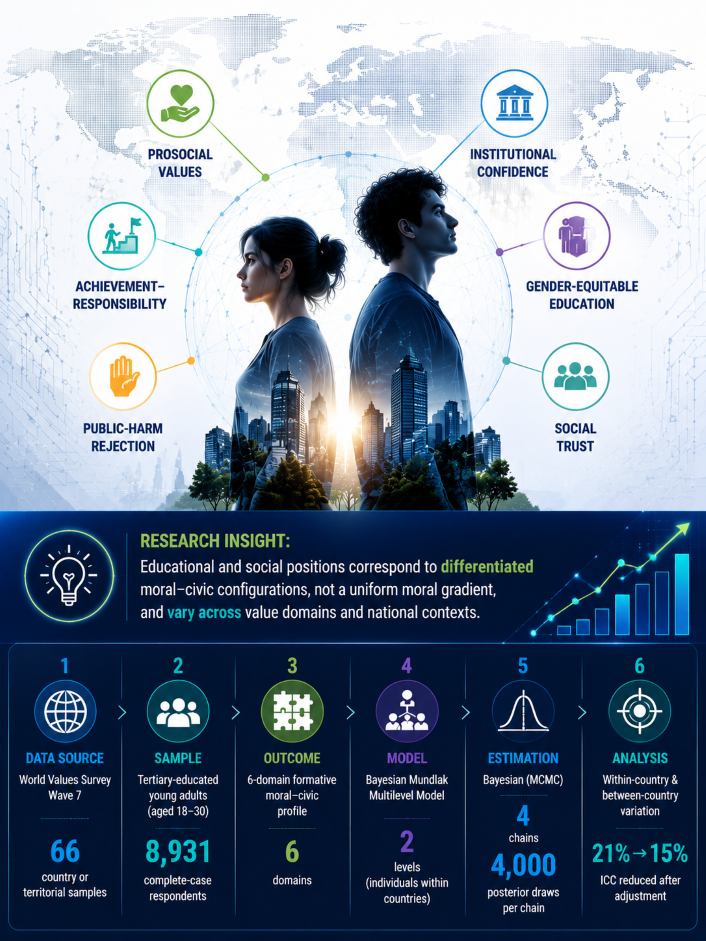
Higher education institutions have a dual purpose: to educate and to socialise moral and civic citizens. While this mandate is widely acknowledged, empirical studies of value formation are often limited to single-case studies or use concepts that are difficult to compare across national contexts. In this study, we propose and test a data-based model of moral and civic value formation using the World Values Survey (WVS) Wave 7. A sample of 9,589 tertiary-educated individuals aged from 18 to 30 in 66 countries was used for the analyses. We used a systematic pre-processing protocol to recode WVS special missing categories, exclude completely missing variables, and build six theoretically-informed, normalized indicators of prosocial values, achievement-responsibility values, moral rejection, institutional trust, gender-equitable education values and social trust. These were then combined into a formative Moral-Civic Value Formation Index (MCVFI). HC3 robust standard error regression models were estimated at the individual level and with country fixed effects. The individual-level model identified education level (β = 0.099, p < 0.001), female gender (β = 0.046, p < 0.001), and family-religious socialization (β = 0.267, p < 0.001) as significant positive predictors. Country fixed effects substantially improved model fit, raising adjusted R² from 0.084 to 0.306. This confirms that moral and civic value formation is context-sensitive and embedded in wider cultural-national environments. The study contributes a reproducible, open-data framework for integrating cross-national public values data into educational research on civic and moral development.
Downloads
Article Details

This work is licensed under a Creative Commons Attribution-ShareAlike 4.0 International License.
Authors who publish with this journal agree to the following terms:
- Copyright of the published article belongs to the authors and grant the journal right of first publication with the work simultaneously licensed under a Creative Commons Attribution-ShareAlike 4.0 (CC BY SA) International License that allows others to share the work with an acknowledgment of the work's authorship and initial publication in this journal.
- Authors are able to enter into separate, additional contractual arrangements for the non-exclusive distribution of the journal's published version of the work (e.g., post it to an institutional repository or publish it in a book), with an acknowledgment of its initial publication in this journal.
- Authors are permitted and encouraged to post their work online (e.g., in institutional repositories or on their website) prior to and during the submission process, as it can lead to productive exchanges, as well as earlier and greater citation of published work (See the Effect of Open Access).
References
[1] N. A. Bowman, “Promoting participation in a diverse democracy: A meta-analysis of college diversity experiences and civic engagement,” Rev. Educ. Res., vol. 81, no. 1, pp. 29–68, 2011, https://doi.org/10.3102/0034654310383047
[2] C. I. Celio, J. Durlak, and A. Dymnicki, “A Meta-Analysis of the Impact of Service-Learning on Students,” J. Exp. Educ., vol. 34, no. 2, pp. 164–181, 2011, https://doi.org/10.1177/105382591103400205
[3] D. S. Hillygus, “The missing link: Exploring the relationship between higher education and political engagement,” Polit. Behav., vol. 27, no. 1, pp. 25–47, 2005, https://doi.org/10.1007/s11109-005-3075-8
[4] A. J. Perrin and A. Gillis, “How College Makes Citizens: Higher Education Experiences and Political Engagement,” Socius, vol. 5, p. 2378023119859708, 2019, https://doi.org/10.1177/2378023119859708
[5] N. Alfirević, M. Arslanagić-Kalajdžić, and Ž. Lep, “The role of higher education and civic involvement in converting young adults’ social responsibility to prosocial behavior,” Sci. Rep., vol. 13, no. 1, p. 2559, 2023, https://doi.org/10.1038/s41598-023-29562-4
[6] H. Feldmann, “Who favors education? Insights from the World values survey,” Comp. Sociol., vol. 19, no. 4–5, pp. 509–541, 2020, https://doi.org/10.1163/15691330-BJA10018
[7] A. Hakhverdian and Q. Mayne, “Institutional trust, education, and corruption: A micro-macro interactive approach,” J. Polit., vol. 74, no. 3, pp. 739–750, 2012, https://doi.org/10.1017/S0022381612000412
[8] P. Koshy, H. Cabalu, and V. Valencia, “Higher education and the importance of values: evidence from the World Values Survey,” High. Educ., vol. 85, no. 6, pp. 1401–1426, 2023, https://doi.org/10.1007/s10734-022-00896-8
[9] J. Huang, H. M. van den Brink, and W. Groot, “College Education and Social Trust: An Evidence-Based Study on the Causal Mechanisms,” Soc. Indic. Res., vol. 104, no. 2, pp. 287–310, 2011, https://doi.org/10.1007/s11205-010-9744-y
[10] F. G. Demirci et al., “Education and Sustainability-Related Orientations: Cross-National Evidence from the World Values Survey,” Sustain., vol. 18, no. 5, p. 2266, 2026, https://doi.org/10.3390/su18052266
[11] K. Milligan, E. Moretti, and P. Oreopoulos, “Does education improve citizenship? Evidence from the United States and the United Kingdom,” J. Public Econ., vol. 88, no. 9–10, pp. 1667–1695, 2004, https://doi.org/10.1016/j.jpubeco.2003.10.005
[12] T. S. Dee, “Are there civic returns to education?,” J. Public Econ., vol. 88, no. 9–10, pp. 1697–1720, 2004, https://doi.org/10.1016/j.jpubeco.2003.11.002
[13] D. E. Campbell, “Civic engagement and education: An empirical test of the sorting model,” Am. J. Pol. Sci., vol. 53, no. 4, pp. 771–786, 2009, https://doi.org/10.1111/j.1540-5907.2009.00400.x
[14] C. D. Kam and C. L. Palmer, “Reconsidering the effects of education on political participation,” J. Polit., vol. 70, no. 3, pp. 612–631, 2008, https://doi.org/10.1017/S0022381608080651
[15] M. Persson, “Education and Political Participation,” Br. J. Polit. Sci., vol. 45, no. 3, pp. 689–703, 2015, https://doi.org/10.1017/S0007123413000409
[16] C. Willeck and T. Mendelberg, “Education and Political Participation,” Annu. Rev. Polit. Sci., vol. 25, pp. 89–110, 2022, https://doi.org/10.1146/annurev-polisci-051120-014235
[17] K. Bollen and R. Lennox, “Conventional wisdom on measurement: A structural equation perspective.,” Psychol. Bull., vol. 110, no. 2, pp. 305–314, 1991, https://doi.org/10.1037/0033-2909.110.2.305
[18] C. B. Jarvis, S. B. Mackenzie, P. M. Podsakoff, N. Giliatt, and J. F. Mee, “A Critical Review of Construct Indicators and Measurement Model Misspecification in Marketing and Consumer Research,” J. Consum. Res., vol. 30, no. 2, pp. 199–218, 2003, https://doi.org/10.1086/376806
[19] A. Diamantopoulos and H. M. Winklhofer, “Index construction with formative indicators: An alternative to scale development,” J. Mark. Res., vol. 38, no. 2, pp. 269–277, 2001, https://doi.org/10.1509/jmkr.38.2.269.18845
[20] J. R. Edwards and R. P. Bagozzi, “On the nature and direction of relationships between constructs and measures,” Psychol. Methods, vol. 5, no. 2, pp. 155–174, 2000, https://doi.org/10.1037/1082-989X.5.2.155
[21] J. R. Edwards, “The fallacy of formative measurement,” Organ. Res. Methods, vol. 14, no. 2, pp. 370–388, 2011, https://doi.org/10.1177/1094428110378369
[22] D. Stegmueller, “How many countries for multilevel modeling? A comparison of frequentist and bayesian approaches,” Am. J. Pol. Sci., vol. 57, no. 3, pp. 748–761, 2013, https://doi.org/10.1111/ajps.12001
[23] E. Davidov, B. Meuleman, J. Cieciuch, P. Schmidt, and J. Billiet, “Measurement equivalence in cross-national research,” Annu. Rev. Sociol., vol. 40, pp. 55–75, 2014, https://doi.org/10.1146/annurev-soc-071913-043137
[24] G. King, C. J. L. Murray, J. A. Salomon, and A. Tandon, “Enhancing the Validity and Cross-Cultural Comparability of Measurement in Survey Research,” Am. Polit. Sci. Rev., vol. 98, no. 1, pp. 191–207, 2004, https://doi.org/10.1017/S000305540400108X
[25] J. Alemán and D. Woods, “Value Orientations From the World Values Survey: How Comparable Are They Cross-Nationally?,” Comp. Polit. Stud., vol. 49, no. 8, pp. 1039–1067, 2016, https://doi.org/10.1177/0010414015600458
[26] Y. Mundlak, “On the Pooling of Time Series and Cross Section Data,” Econometrica, vol. 46, no. 1, p. 69, 1978, https://doi.org/10.2307/1913646
[27] A. Bell and K. Jones, “Explaining Fixed Effects: Random Effects Modeling of Time-Series Cross-Sectional and Panel Data,” Polit. Sci. Res. Methods, vol. 3, no. 1, pp. 133–153, 2015, https://doi.org/10.1017/psrm.2014.7
[28] C. K. Enders and D. Tofighi, “Centering Predictor Variables in Cross-Sectional Multilevel Models: A New Look at an Old Issue,” Psychol. Methods, vol. 12, no. 2, pp. 121–138, 2007, https://doi.org/10.1037/1082-989X.12.2.121
[29] I. R. White and J. B. Carlin, “Bias and efficiency of multiple imputation compared with complete-case analysis for missing covariate values,” Stat. Med., vol. 29, no. 28, pp. 2920–2931, 2010, https://doi.org/10.1002/sim.3944
[30] G. Solon, S. J. Haider, and J. M. Wooldridge, “What are we weighting for?,” J. Hum. Resour., vol. 50, no. 2, pp. 301–316, 2015, https://doi.org/10.3368/jhr.50.2.301
[31] C. Young and K. Holsteen, “Model Uncertainty and Robustness: A Computational Framework for Multimodel Analysis,” Sociol. Methods Res., vol. 46, no. 1, pp. 3–40, 2017, https://doi.org/10.1177/0049124115610347
[32] U. Simonsohn, J. P. Simmons, and L. D. Nelson, “Specification curve analysis,” Nat. Hum. Behav., vol. 4, no. 11, pp. 1208–1214, 2020, https://doi.org/10.1038/s41562-020-0912-z
[33] S. Steegen, F. Tuerlinckx, A. Gelman, and W. Vanpaemel, “Increasing Transparency Through a Multiverse Analysis,” Perspect. Psychol. Sci., vol. 11, no. 5, pp. 702–712, 2016, https://doi.org/10.1177/1745691616658637
[34] C. Haerpfer et al., “World Values Survey: Round Seven – Country-Pooled Datafile Version 6.0.” JD Systems Institute & WVSA Secretariat Madrid, Spain & Vienna, Austria, 2022. https://doi.org/10.14281/18241.24
[35] Y. Benjamini and Y. Hochberg, “Controlling the False Discovery Rate: A Practical and Powerful Approach to Multiple Testing,” J. R. Stat. Soc. Ser. B Stat. Methodol., vol. 57, no. 1, pp. 289–300, 1995, https://doi.org/10.1111/j.2517-6161.1995.tb02031.x
[36] M. Vecchione, S. Schwartz, G. Alessandri, A. K. Döring, V. Castellani, and M. G. Caprara, “Stability and change of basic personal values in early adulthood: An 8-year longitudinal study,” J. Res. Pers., vol. 63, pp. 111–122, 2016, https://doi.org/10.1016/j.jrp.2016.06.002
[37] L. Sagiv and S. H. Schwartz, “Personal Values Across Cultures,” Annu. Rev. Psychol., vol. 73, pp. 517–546, 2022, https://doi.org/10.1146/annurev-psych-020821-125100
[38] S. H. Schwartz, “An Overview of the Schwartz Theory of Basic Values,” Online Readings Psychol. Cult., vol. 2, no. 1, 2012, https://doi.org/10.9707/2307-0919.1116
[39] K. Newton and S. Zmerli, “Three forms of trust and their association,” Eur. Polit. Sci. Rev., vol. 3, no. 2, pp. 169–200, 2011, https://doi.org/10.1017/S1755773910000330
[40] F. Herreros and R. López-Pérez, “Education and generalized trust: a test of two mechanisms,” J. Institutional Econ., vol. 22, p. e6, 2026, https://doi.org/10.1017/S1744137426100435
[41] R. Inglehart and W. E. Baker, “Modernization, cultural change, and the persistence of traditional values,” Am. Sociol. Rev., vol. 65, no. 1, pp. 19–51, 2000, https://doi.org/10.2307/2657288
[42] P. Paxton, “Social Capital and Democracy: An Interdependent Relationship,” Am. Sociol. Rev., vol. 67, no. 2, pp. 254–277, 2002, https://doi.org/10.1177/000312240206700205
[43] B. Meuleman et al., “Why Measurement Invariance is Important in Comparative Research. A Response to Welzel et al. (2021),” Sociol. Methods Res., vol. 52, no. 3, pp. 1401–1419, 2023, https://doi.org/10.1177/00491241221091755
[44] M. L. Bryan and S. P. Jenkins, “Multilevel modelling of country effects: A cautionary tale,” Eur. Sociol. Rev., vol. 32, no. 1, pp. 3–22, 2016, https://doi.org/10.1093/esr/jcv059
[45] OECD, Eurostat, and UNESCO, “ISCED 2011 operational manual: Guidelines for classifying national education programmes and related qualifications.” OECD Publishing, 2015. https://doi.org/10.1787/9789264228368-en
[46] J. K. Kruschke, “Bayesian Analysis Reporting Guidelines,” Nat. Hum. Behav., vol. 5, no. 10, pp. 1282–1291, 2021, https://doi.org/10.1038/s41562-021-01177-7
[47] E. von Elm, D. G. Altman, M. Egger, S. J. Pocock, P. C. Gøtzsche, and J. P. Vandenbroucke, “The Strengthening the Reporting of Observational Studies in Epidemiology (STROBE) statement: guidelines for reporting observational studies.,” Lancet, vol. 370, no. 9596, pp. 1453–1457, 2007, https://doi.org/10.1016/S0140-6736(07)61602-X
[48] A. C. Carle, “Fitting multilevel models in complex survey data with design weights: Recommendations,” BMC Med. Res. Methodol., vol. 9, no. 1, p. 49, 2009, https://doi.org/10.1186/1471-2288-9-49
[49] T. Lumley, “Analysis of complex survey samples,” J. Stat. Softw., vol. 9, no. 8, pp. 1–19, 2004, https://doi.org/10.18637/jss.v009.i08
[50] S. R. Seaman and I. R. White, “Review of inverse probability weighting for dealing with missing data,” Stat. Methods Med. Res., vol. 22, no. 3, pp. 278–295, 2013, https://doi.org/10.1177/0962280210395740
[51] A. Diamantopoulos, P. Riefler, and K. P. Roth, “Advancing formative measurement models,” J. Bus. Res., vol. 61, no. 12, pp. 1203–1218, 2008, https://doi.org/10.1016/j.jbusres.2008.01.009
[52] K. A. Bollen and A. Diamantopoulos, “In defense of causal-formative indicators: A minority report.,” Psychol. Methods, vol. 22, no. 3, pp. 581–596, 2017, https://doi.org/10.1037/met0000056
[53] L. J. Cronbach, “Coefficient alpha and the internal structure of tests,” Psychometrika, vol. 16, no. 3, pp. 297–334, 1951, https://doi.org/10.1007/BF02310555
[54] A. Gelman, J. B. Carlin, H. S. Stern, D. B. Dunson, A. Vehtari, and D. B. Rubin, Bayesian Data Analysis, 3rd ed. CRC Press, 2013. https://doi.org/10.1201/b16018
[55] A. Gelman and D. Simpson, “Rank-normalization, folding, and localization: An improved R-hat for assessing convergence of MCMC,” Bayesian Anal., vol. 16, no. 2, pp. 1–26, 2004.
[56] A. Vehtari, A. Gelman, D. Simpson, B. Carpenter, and P. C. Burkner, “Rank-normalization, folding, and localization: An improved R-hat for assessing convergence of MCMC,” Bayesian Anal., vol. 16, no. 2, pp. 667–718, 2021, https://doi.org/10.1214/20-BA1221
[57] J. Gabry, D. Simpson, A. Vehtari, M. Betancourt, and A. Gelman, “Visualization in Bayesian workflow,” J. R. Stat. Soc. Ser. A Stat. Soc., vol. 182, no. 2, pp. 389–402, 2019, https://doi.org/10.1111/rssa.12378
[58] I. T. Jollife and J. Cadima, “Principal component analysis: A review and recent developments,” Philos. Trans. R. Soc. A Math. Phys. Eng. Sci., vol. 374, no. 2065, p. 20150202, 2016, https://doi.org/10.1098/rsta.2015.0202
[59] R. M. O’Brien, “A caution regarding rules of thumb for variance inflation factors,” Qual. Quant., vol. 41, no. 5, pp. 673–690, 2007, https://doi.org/10.1007/s11135-006-9018-6
[60] K. Kizilova, J. Diez‐Medrano, C. Welzel, and C. Haerpfer, “Harmonization in the world values survey,” Surv. Data Harmon. Soc. Sci., pp. 39–56, 2024.
[61] A. Bell, M. Fairbrother, and K. Jones, “Fixed and random effects models: making an informed choice,” Qual. Quant., vol. 53, no. 2, pp. 1051–1074, 2019, https://doi.org/10.1007/s11135-018-0802-x
[62] K. A. Bollen and S. Bauldry, “Three Cs in Measurement Models: Causal Indicators, Composite Indicators, and Covariates,” Psychol. Methods, vol. 16, no. 3, pp. 265–284, 2011, https://doi.org/10.1037/a0024448
[63] T. Fryer, “Do the political attitudes of students change during their time in higher education?,” High. Educ., vol. 86, no. 3, pp. 563–590, 2023, https://doi.org/10.1007/s10734-022-00915-8
[64] K. Noordzij, W. de Koster, and J. van der Waal, “Explaining the educational gradient in trust in politicians: a video-vignette survey experiment,” West Eur. Polit., vol. 47, no. 4, pp. 784–812, 2024, https://doi.org/10.1080/01402382.2023.2250163
[65] L. Hooghe, G. Marks, J. Kamphorst, and J. Schulte-Cloos, “Education and political attitudes: The power and limits of field theory,” Perspect. Polit., pp. 1–16, 2026, https://doi.org/10.1017/S1537592726104824
[66] P. Alscher, U. Ludewig, and N. McElvany, “Civic Education, Teaching Quality and Students’ Willingness to Participate in Political and Civic Life: Political Interest and Knowledge as Mediators,” J. Youth Adolesc., vol. 51, no. 10, pp. 1886–1900, 2022, https://doi.org/10.1007/s10964-022-01639-9
[67] W. Schulz, “Young people’s trust in institutions, civic knowledge and their dispositions toward civic engagement,” Large-Scale Assessments Educ., vol. 12, no. 1, p. 23, 2024, https://doi.org/10.1186/s40536-024-00210-1
[68] S. E. Finkel, A. Neundorf, and E. Rascón Ramírez, “Can Online Civic Education Induce Democratic Citizenship? Experimental Evidence from a New Democracy,” Am. J. Pol. Sci., vol. 68, no. 2, pp. 613–630, 2024, https://doi.org/10.1111/ajps.12765
[69] J. Oser, F. Feitosa, and R. Dassonneville, “Who Feels They Can Understand and Have an Impact on Political Processes? Socio-demographic Correlates of Political Efficacy in 46 Countries, 1996–2016,” Int. J. Public Opin. Res., vol. 35, no. 2, p. edad013, 2023, https://doi.org/10.1093/ijpor/edad013
[70] B. G. Robbins, “Valid and Reliable Measures of Generalized Trust: Evidence from a Nationally Representative Survey and Behavioral Experiment,” Socius, vol. 9, pp. 1–26, 2023, https://doi.org/10.1177/23780231231192841
[71] T. D. Hudson, A. N. Rockenbach, and M. J. Mayhew, “Campus Conditions and College Experiences that Facilitate Friendship Across Worldview Differences,” J. Higher Educ., vol. 94, no. 2, pp. 227–255, 2023, https://doi.org/10.1080/00221546.2022.2082785
[72] J. Bleck, R. Dowd, D. Guzman, J. Mugo, and J. Oluoch-Aridi, “Can Student Body Diversity Foster Inter-ethnic Trust, Tolerance, and National Identification Prioritization? The Role of Friendship in Kenya,” Br. J. Polit. Sci., vol. 55, 2025, https://doi.org/10.1017/S0007123425100690
[73] V. Zimmer and M. Stein, “Akzeptanz gesellschaftlicher Diversität durch junge Muslim:innen und Christ:innen in Abhängigkeit der Stärke der Religiosität und interreligiöser Kontakte,” Zeitschrift für Relig. Gesellschaft und Polit., vol. 6, no. 2, pp. 399–429, 2022, https://doi.org/10.1007/s41682-022-00111-6
[74] E. Chan and D. Di, “Faithfully Gendered? How Religious Attendance Shapes Views of Women’s Leadership in Politics and Business Cross-Nationally,” Socius, vol. 10, p. 23780231241286376, 2024, https://doi.org/10.1177/23780231241286377
[75] J. Bleck, J. Bonan, P. Lemay-Boucher, and B. Sarr, “Drinking Tea with the Neighbors: Informal Clubs, General Trust, and Trustworthiness in Mali,” Am. Polit. Sci. Rev., vol. 118, no. 2, pp. 744–763, 2024, https://doi.org/10.1017/S0003055423000709
[76] F. Herreros, “The State and Trust,” Annu. Rev. Polit. Sci., vol. 26, pp. 117–134, 2023, https://doi.org/10.1146/annurev-polisci-051921-102842
[77] E. Davidov, H. Dülmer, E. Schlüter, P. Schmidt, and B. Meuleman, “Using a Multilevel Structural Equation Modeling Approach to Explain Cross-Cultural Measurement Noninvariance,” J. Cross. Cult. Psychol., vol. 43, no. 4, pp. 558–575, 2012, https://doi.org/10.1177/0022022112438397